Multimeter
A 6000-count meter, not an ideal probe: 10 MΩ input, contact resistance, diode test. Capacitance reads high in circuit. The 10 A input only works in series.
> board-level repair trainer
DEADBOARD is a repair bench in your browser. Probe a real open-hardware board with a multimeter, read boot current off the bench supply, scope the switch nodes, find the short with a thermal camera, then fix it with an iron that obeys physics.
Runs in Chrome or Edge 113+, Safari 26+ (WebGPU). Nothing to install.
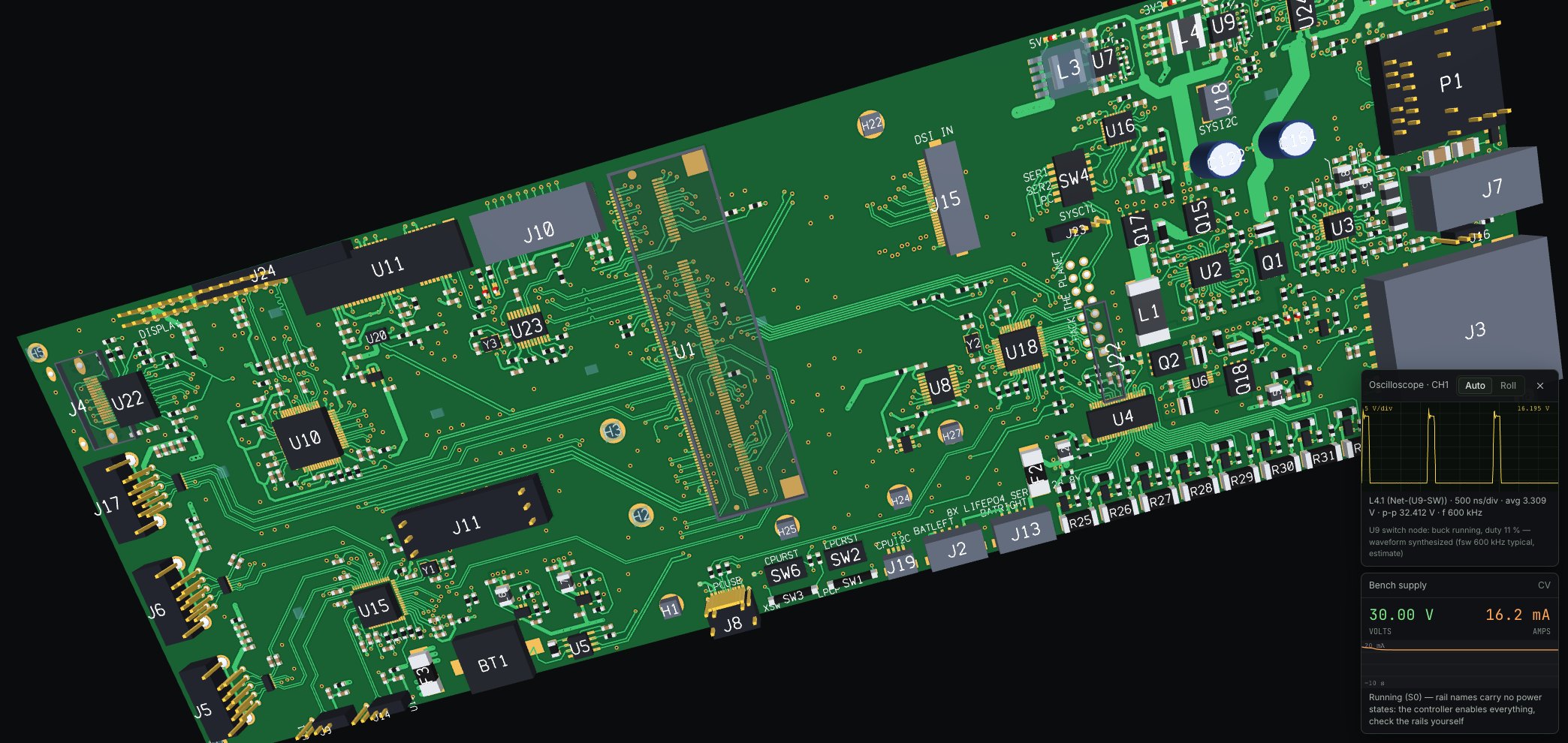
$ power on --supply 30V --rail 30V_GATE
G3H   standby .....................  0.0 mA
seq   S5 → S4 → S3 → S0 ...........  0.0 mA
S0    +5V +3V3 +1V2 up ............ 10.3 mA
S0    loads settle ................ 16.2 mA
ok    board alive
That's the board above, powering up on the bench (its rail names carry no power states, so every converter starts at S0). A stuck rail stalls the sequence. A short makes it loop.
> the bench
Every tool a technician reaches for, with the same quirks and the same limits.
A 6000-count meter, not an ideal probe: 10 MΩ input, contact resistance, diode test. Capacitance reads high in circuit. The 10 A input only works in series.
Boot current you can read: standby, sleep, running. Current limit, and voltage injection to make the culprit on a shorted rail heat up.
Roll through power-up ramps and boot loops. Catch a switch node, its ripple, or a clock that never started.
IR that reads like IR: bare solder looks cold. Freeze spray, isopropyl and the rosin method to pin the hot part.
Iron, hot air, preheater. Flux matters, ground pads fight back, and pads lift if you cook them.
Both sides, 2D or a full 3D orbit. Click a part to see where its nets go. Search hundreds of parts in a keystroke.
> the faults
Not "part missing, find it". Faults come with realistic severity and realistic symptoms. Some only show up when the board is warm, or when you press on it.
> real boards
Import a boardview (.brd) or a KiCad layout. DEADBOARD finds the power tree, the regulators and the power states from the netlist and its net names, then simulates the whole board with a SPICE engine. Export it as an ngspice netlist whenever you like.
> honest simulation
Values come from the board data, datasheets and design intent. Where none exist, the estimate is labelled as an estimate, and synthesized waveforms say so on the scope. Measured a real board? Feed the readings back and DEADBOARD calibrates its model against your bench.
> challenges
Start from a working board, plant faults, and lock a flag to the repaired circuit. The flag is encrypted with the board's topology, so only a real repair unlocks it. There's no peeking and no shortcut. Share it as a file or a single link.
$ verify
✗ V(TP1) = 0.42 V   expected 2.30–2.70 V
✗ D1 is OFF          expected ON
# …swap R2 for 10 kΩ, bridge the broken bottom trace…
$ verify
✓ all checks green
✓ flag captured: PCB{…}